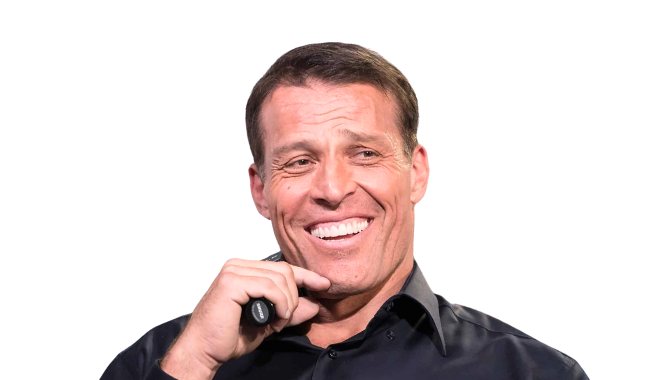

Jay Shetty & Tony Robbins ON Making Better Decisions
In this On Purpose episode, Jay Shetty sat down with Tony Robbins, a number-one New York Times bestselling author and entrepreneur with 114 companies. Robbins has dedicated his life to helping individuals and organizations bridge the gap between where they are and where they want to be. Today, he discussed the fundamental mechanics of decision-making, the distinction between achievement and fulfillment, and the seasons that define our human experience.
Have you ever felt like you were standing at a crossroads, paralyzed by the fear that one wrong turn could ruin everything?
In this On Purpose episode, Jay Shetty sat down with Tony Robbins, a number-one New York Times bestselling author and entrepreneur with 114 companies. Robbins has dedicated his life to helping individuals and organizations bridge the gap between where they are and where they want to be. Today, he discussed the fundamental mechanics of decision-making, the distinction between achievement and fulfillment, and the seasons that define our human experience.
Your Future Is in Your Hands
Jay Shetty asked Tony Robbins what someone should do when they feel stuck in a relationship, career, or life in general. He responded that being stuck is a failure to make decisions, and that it's usually due to fear. People are afraid to make the wrong decision and fear the consequences that might follow. However, our decisions directly impact the quality of our lives.
Many people believe their circumstances dictate their happiness, but Tony Robbins disagrees. He told Jay Shetty that he grew up in a house with physical abuse and financial instability, and his mindset helped him overcome his condition.
Robbins explained that stress is measured by how much we feel events control us vs. how much we control them. Modern society struggles with record-high mental health issues, and people drown in information while they starve for wisdom. He believes that people must embrace their role as creators and understand that their current situation was created by a series of decisions they made. Now, you can make new ones to alter your life's course.
The Three-Step Process of Action
Tony Robbins told Jay Shetty that people believe deciding is a one-step process; in reality, it involves three stages:
- Decision
- Commitment
- Resolve
The word "decision" comes from the Latin "decidere", which means to cut off. A real decision involves cutting off any other possibility except the one you committed to. Robbins told Jay Shetty that we mustn't allow ourselves an escape route, because the brain will always seek safety if it discovers one.
Decisions give direction, but we need commitment to stay on that path for the long haul. Tony Robbins explained to Jay Shetty that commitments mean ensuring that a decision doesn't evaporate when we are no longer inspired. His personal rule is to take immediate action that commits him to follow through with his decision, such as booking a meeting or enrolling in a class.
Resolve is the moment when the inner war ends and you feel at peace with the decision you made. To Tony Robbins, resolve is a state of absolute certainty, where fear and anxiety no longer exist.
The OOC EMR Decision-Making Framework
Tony Robbins shared a six-step process to help those facing significant choices, which he calls OOC EMR:
- O – Outcome. Get crystal clear on what you want rather than what you are afraid of.
- O – Options. You must have at least three options to make it a real choice.
- C – Consequences. List the upsides and downsides of each option.
- E – Evaluate. Determine the actual probability of the consequences.
- M – Mitigation. Find ways to reduce the downsides by blending different options.
- R – Resolve. Make the ultimate commitment to the chosen path.
Robbins shared with Jay Shetty an anecdote from General Norman Schwarzkopf about the importance of decision-making in leadership. He recalled witnessing a high-ranking general make a crucial decision in 40 minutes, despite the organization's prolonged debates. He asserted that making a decision, good or bad, accelerates progress and clarity, unlike hesitation. So, Robbins believes that inaction is often the worst decision.
Achievement vs. Fulfillment
Tony Robbins told Jay Shetty there is a clear distinction between achievement and fulfillment. Achievement is like science, because it involves universal, repeatable patterns that lead to success. There is a science to financial freedom or physical health: if you follow certain patterns, you get specific results; if you violate them, you fail or get ill.
But Robbins argues that achievement without fulfillment is the ultimate failure. He told Jay Shetty that fulfillment is an art because it's entirely unique for each individual. While someone might find fulfillment in raising a family, another may find it in writing poetry or building a business. Robbins explains that while the Western world promotes achievement, it rarely teaches the art of fulfillment, rooted in two things: growth and contribution.
Problems Are Necessary
When Tony Robbins was young, his mentor, Vincent Peale, told him that the only people without problems are in cemeteries. He added that we should pray for problems, because they are a sign of life and the main catalyst for spiritual evolution. Just as a boxer builds muscle by pushing against resistance, humans develop their souls by pushing against life's challenges.
Contrary to the modern view that we should seek comfort to achieve happiness, Tony Robbins believes that comfort doesn't create strength. He told Jay Shetty that, while self-care is essential for maintaining your energy, it has become a new hustle culture that focuses on doing less. He shared a study where unhappy people were forced to do five times more activity; surprisingly, their productivity and life satisfaction increased by almost 20%, because now they felt in control of their lives again.1
Self-Esteem Is Earned
Tony Robbins told Jay Shetty that self-esteem is not something that can be achieved externally but must be earned by the self, with the self. Telling a child they are beautiful or smart doesn't necessarily build their esteem; on the contrary, it can even increase anxiety if the child feels they can't live up to the labels. However, someone who was told they were worthless can develop high self-esteem by deciding to prove those voices wrong.
Robbins explained to Jay Shetty that humans build true self-esteem by doing difficult things they know are right. When we push through a challenge or stay disciplined when it's inconvenient, we feel more empowered, and our self-esteem grows. In Robbins' view, we must learn grit and how to handle discomfort, because comfort doesn't foster growth.
The Four Seasons of Life
Tony Robbins explains to Jay Shetty that life, like nature, moves in seasons, and we must understand which season we are in. According to him, life is split into four seasons:
- Spring (0-21) – A time to be nurtured and to learn.
- Summer (22-42) – A testing time, when we test if the lessons learned in spring apply to the real world.
- Autumn (43-63) – The reward stage, a time when you reap what you've sown.
- Winter (from 64) – The stage of wisdom and legacy.
Robbins told Jay Shetty that people who put in the work in spring and summer will have the highest income and the most fulfilling relationships. In winter, people no longer need to prove anything and can focus entirely on their contribution to the world. He warns that you must understand the season of life you are in, because taking action that doesn't align with it might leave you disappointed.
It Has to Make Sense to You
Robbins's friend, Steve Wynn, once bought a painting he really wanted to show to his friend. Robbins went to see it: it was a painting by Mark Rothko, which had cost $86.9 million. To him, it was a giant orange square, nothing more. He even joked he could replicate it with $100 worth of paint and twenty minutes. But, to Wynn, it was a masterpiece. He felt fulfilled looking at it, and understood the meaning behind each brushstroke and the artist's history.
Tony Robbins told Jay Shetty that fulfillment is individual, and no two people will feel the same way about something. He explained that it comes down to what you choose to focus on and what meaning you assign to it. While one person may see an orange square, the other one sees a masterpiece. On the other hand, lacking a clear purpose will move you further away from feeling fulfilled. So, he advised the audience to seek progress on things that are meaningful to them.
Living Your Best Life
Tony Robbins opened up to Jay Shetty about his relationship with divinity. He identifies as Christian, but maintains a broad spiritual outlook. In his opinion, every human should have a relationship with God as unique as their signature. To him, spirituality is a personal experience, focused on celebration and contribution rather than a set of rules.
Robbins told Jay Shetty a story about a gambler who died and arrived in heaven, where he would win every hand of blackjack and would get everything he desired. However, after three weeks of a winning streak, he became miserable and angry because he kept winning. The moral of the story is that, when everything is handed to you and resources are unlimited, life has no value anymore. That is why we must make the best of our limited lives, grow, and serve a purpose greater than ourselves, to ensure that our time on earth is well spent and fulfills us.
More From Jay Shetty
Listen to the entire On Purpose with Jay Shetty podcast episode “Tony Robbins: The Fastest Way Out of Feeling Stuck! Use THIS 6-Part Decision Making Framework to Take the First Step and Start 2026 With Clarity” now in the iTunes store or on Spotify. For more inspirational stories and messages like this, check out Jay’s website at jayshetty.me.
1Laura Vanderkam, Tranquility by Tuesday: 9 Ways to Calm the Chaos and Make Time for What Matters (New York: Portfolio/Penguin, 2022), 15-28.
Sign up for the only email that puts purpose at the center of your day.


Looking for greater meaning? This quiz shows you how to live with purpose every day.
Take the Quiz
Dreaming of becoming a life coach? This quiz tells you if a coaching career is right for you.
Take the QuizDreaming of becoming a life coach? This quiz tells you if a coaching career is right for you.
Take the Quiz
Everyone communicates differently. Discover your own personal fight style now.
Take the Quiz
Understanding your role in a relationship is the first step to making things work.
Take the Quiz