



Jay Shetty & Roxie Nafousi ON How to Become More Confident
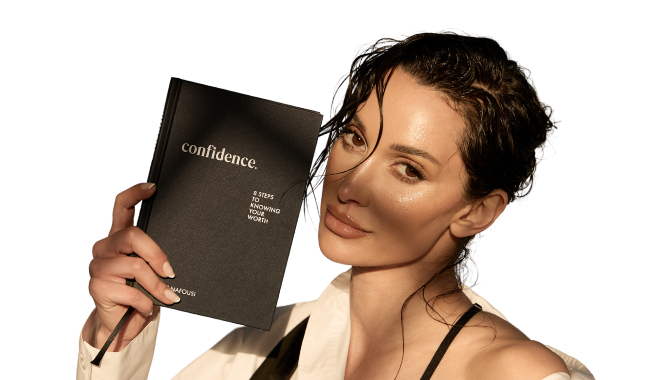
In this On Purpose episode, Jay Shetty welcomed Roxie Nafousi, best-selling author of Manifest and her newly released book, Confidence: Eight Steps to Knowing Your Worth. Nafousi talked about how confidence is more than just a loud personality; it's a sense of self-worth that dictates how we face each area of our lives.
Have you ever walked into a room and felt like every pair of eyes was scrutinizing your every flaw, only to leave and spend the entire car ride home agonizing over what people thought of you?
In this On Purpose episode, Jay Shetty welcomed Roxie Nafousi, best-selling author of Manifest and her newly released book, Confidence: Eight Steps to Knowing Your Worth. Nafousi talked about how confidence is more than just a loud personality; it's a sense of self-worth that dictates how we face each area of our lives.
Confidence Is Quiet
To Roxie Nafousi, confidence is about self-worth and the internal knowledge that you are enough exactly as you are. She told Jay Shetty that, contrary to the common belief, confidence doesn't equal extroversion, charisma, or loudness. Instead, it's grounding, quiet, and stable, she added. Nafousi summarized confidence as the ability to walk into any room unapologetically as yourself and leave it without worrying about others' opinions of you.
Jay Shetty observed that most people tend to do the exact opposite – overanalyze every minor social interaction and wonder how others perceived them. Nafousi explained that confidence manifests differently for extroverts and introverts: while extroverts may feel comfortable being the center of attention, introverts show confidence by remaining quiet, not feeling the need to prove themselves to anyone.
The Evolution and Danger of Seeking External Validation
Humans have always sought validation, Nafousi told Jay Shetty. However, what used to be natural for human growth and social cohesion mutated into a measuring stick for worth. Historically, humans needed to belong to a tribe to ensure survival, but modern society has turned it into an obsession with external opinions, amplified by social media, where our worth is now measured in the number of likes and followers.
Roxie Nafousi warned that excessive reliance on external feedback can dangerously impact our self-perception. She shared the example of someone sharing a family photo that they love, only to end up feeling like the picture was terrible because it didn't receive enough likes. Nafousi advises that, instead of blaming the social media algorithm, people must start re-evaluating their own judgment and worth, and no longer seek external sources to tell them what to think about themselves.
Your Thoughts Impact Your Actions
In the first chapter of her new book, Nafousi writes that the mind can be either a home or a prison, and the choice belongs only to you. She told Jay Shetty that thoughts repeated enough times eventually become beliefs that act as a filter through which every interaction and experience is interpreted. If you think you're bad with people, you're more likely to focus on negative social cues and ignore positive ones. This way, you create a self-fulfilling prophecy of social failure.
For instance, if a comedian on stage is being taunted by the audience, they would feel nervous, start overthinking their words, and likely stumble or stutter. On the other hand, if the audience is supportive and cheers, they are more likely to deliver an impeccable performance and remember the jokes effortlessly.
Nafousi argues that most people waste a lot of energy on internal dialogue, which prevents them from ever putting their best foot forward in life. She and Jay Shetty agree that in today's world, inner self-criticism is incessant, starting from the moment we wake up and look in the mirror.
Self-Awareness vs. the Inner Critic
There is a fine line between self-awareness and self-criticism. Nafousi explained to Jay Shetty that the distinction is in the intention. Self-criticism manifests as an internal attack, telling yourself that you are bad, ugly, stupid, etc. On the other hand, self-awareness is a compassionate observation and the grace to admit that you may need improvement in certain areas of your life.
It's essential to show yourself compassion. Roxie Nafousi gave the example of teaching a child: if you berate them for failing at math, they will likely be traumatized and hate the subject forever. Still, we talk to ourselves that way when we feel like we're falling short. Jay Shetty added that we need to shift the inner conversation and talk to ourselves the way we would speak to our inner child. It's not easy to shift from an inner critic to acceptance and, eventually, to an inner cheerleader, but it's not impossible.
Stepping Into Your Higher Self
Nafousi told Jay Shetty that we all have a Higher Self, but it is not a given that we step into it from the beginning. She explained the process: you must first visualize the most empowered version of yourself a year from now. Picture clearly how this future version walks, talks, and interacts with others. Then, try to slowly bring that person to life in the present, so you can eventually become them.
Roxie Nafousi believes that life is a cumulation of thousands of daily decisions. It's important, she added, that you take a moment before any important decision to reflect and ask yourself, "What would my Higher Self do"? Jay Shetty noted that these actions are more than simply positive thinking; it's rehearsing to become the person you wish to be, until it becomes reality. Acting confidently may reveal skills that were stifled by fear.
The Four Essential Truths
When Nafousi realized she didn't need everyone's approval, a weight lifted from her shoulders. She shared with Jay Shetty the four truths that helped her combat the fear of judgment:
- You're not the main character in anyone else's story. It's important to understand that nobody thinks about you as much as you may think they do, and they don't perceive your flaws with the same intensity that you do.
- You will never know what someone else is truly thinking. You may misinterpret someone's emotions through your filter, without knowing the full picture.
- It's impossible to please everyone all the time. Even the most popular people are disliked or misunderstood by others.
- Connection is all about energy; just as you sometimes click with someone immediately, you can also energetically clash with others.
People Pleasing Is About You
There is a difference between wanting to make others happy and being a people pleaser. Nafousi explained to Jay Shetty that when you want to make others happy, it comes from a place of abundance – you feel good about yourself and have a surplus of love to share with others.
On the other hand, people-pleasing comes from low self-esteem and a desperate need for validation. It's important to understand that people-pleasing is more about you than the ones you're trying to make happy. When we want to please others, we often wear a mask and ignore our own boundaries, just so that others see us as a nice person. But if you are confident, you can be both kind and honest, yet maintain your boundaries, because your identity isn't tied to others' approval. Jay Shetty emphasized that, while caring about other people's opinions is necessary for social connection, it should never replace our own opinion of ourselves.
The Pain of Rejection
To efficiently counter rejection, you must practice radical acceptance, Nafousi told Jay Shetty. While rejection is painful, we can learn to deal with it without spiraling into overthinking. She explained that it feels worse because of the narratives we build around it, rather than the event itself. Another person's opinion is often a reflection of their own past wounds, experiences, and current state of mind, rather than a factual assessment of our character.
Jay Shetty explained the Buddhist concept of the second arrow: the first arrow that hits you is the initial hurt or conflict, which is often outside of our control. The second arrow, however, is the one we fire at ourselves by attaching a painful meaning to the event, such as "I'm not good enough".
Nafousi stated that our minds constantly fill in the blanks, where we miss the entire picture. We create nightmare versions of stories that simply don't exist. Therefore, it's crucial to understand that we can't always trust our internal stories, and we should strive to become more objective so we can move forward more easily.
Struggling With Body Image
Roxie Nafousi candidly shared with Jay Shetty her struggles with Body Dysmorphic Disorder (BDD). Despite being a successful author, she spent years feeling monstrous and grotesque. It culminated in her refusing to leave the house during her pregnancy, because she felt too revolting to be seen.
Nafousi was convinced that it was a matter of changing her appearance to feel better, so she opted for a rhinoplasty. Yet the feelings of self-loathing remained unchanged. She eventually realized that BDD is an anxiety disorder related to OCD (Obsessive-Compulsive Disorder), and it manifested in an obsessive fixation on perceived flaws. She even struggled with panic attacks before going on camera, fearing that her appearance would repel her audience.
Roxie Nafousi told Jay Shetty that she learned to manage these intrusive thoughts through therapy, inner work, and anxiety medication. While she still has some flare-ups when stressed, these methods have helped her feel more grounded and considerably improved her quality of life. Now, she knows how to manage the negative thoughts and genuinely likes herself.
You're Worthy of Celebration
Jay Shetty and Roxie Nafousi discuss the habit of celebrating oneself. Nafousi notes that our society glorifies humility to the point of self-deprecation. Moreover, cultural beliefs, such as the evil eye, can make one subconsciously fear showing too much success or happiness, because they may attract jealousy. It's not uncommon for people to refrain from celebrating wins because they feel it's arrogant to do so.
However, arrogance is a lack of self-awareness; confident people acknowledge their hard work and growth, and can celebrate them without showing off. Nafousi encourages the audience to honor their evolution, no matter how small. Moreover, she suggests creating a personal CV of everyday qualities rather than professional achievements. Train yourself to see the good in the world.
Finally, Nafousi wanted to remind the audience that true confidence is the knowledge that one's worth is never up for discussion.
More From Jay Shetty
Listen to the entire On Purpose with Jay Shetty podcast episode “Roxie Nafousi: Struggle With Low Self-Worth & No Confidence? (Use This Life-Changing 3-Step Method!)” now in the iTunes store or on Spotify. For more inspirational stories and messages like this, check out Jay’s website at jayshetty.me.
Disclaimer: This episode reflects Roxie Nafousi’s personal experiences and perspectives. It is not medical, psychological, or therapeutic advice. Any references to health, diet, or lifestyle practices are her individual choices and may not be suitable for everyone. Results and experiences vary. Always consult a qualified professional before making changes to your health, wellness, or personal care routines.
Sign up for the only email that puts purpose at the center of your day.


Looking for greater meaning? This quiz shows you how to live with purpose every day.
Take the Quiz
Dreaming of becoming a life coach? This quiz tells you if a coaching career is right for you.
Take the QuizDreaming of becoming a life coach? This quiz tells you if a coaching career is right for you.
Take the Quiz
Everyone communicates differently. Discover your own personal fight style now.
Take the Quiz
Understanding your role in a relationship is the first step to making things work.
Take the Quiz
