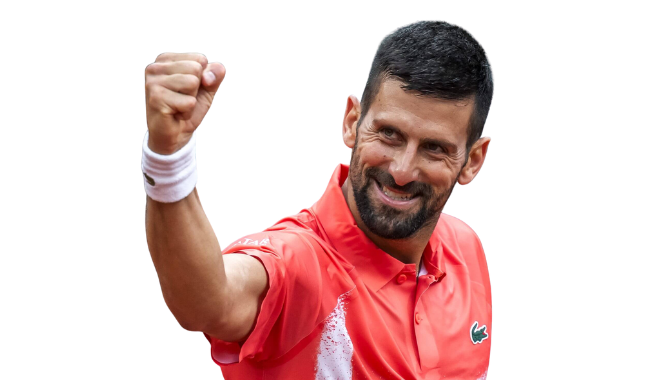

Jay Shetty & Novak Djokovic ON Turning Self-Doubt into Success
In this On Purpose episode, Jay Shetty welcomed Novak Djokovic, the world’s number one male tennis player, who has accumulated an astonishing 24 Grand Slams during his glittering career. Djokovic shared details about the work behind his success, his mentors, and the struggles that shaped him.
Is it possible to be on top of the world while fighting unseen battles?
In this On Purpose episode, Jay Shetty welcomed Novak Djokovic, the world’s number one male tennis player, who has accumulated an astonishing 24 Grand Slams during his glittering career. Djokovic shared details about the work behind his success, his mentors, and the struggles that shaped him.
Training Both Body and Mind
Novak Djokovic explained to Jay Shetty that his success is not accidental; he was fortunate to be guided early in his career toward internal work and a multidisciplinary approach to self-care. He talked about the extent of preparation, which included physical, mental, and emotional prevention and recovery.
Djokovic was introduced to this holistic concept when he was only ten, by his “tennis mother,” as he calls his first mentor. He believes that having a guide to the internal world at such an early age played a foundational role in his later development. Yet even now, decades later, there is still more internal work that requires his attention. Djokovic told Jay Shetty that growth is a lifelong process and that what worked in the past is not necessarily a guarantee that it will continue to work in the future.
The Foundation of Discipline
When he started playing tennis, Djokovic relied on his mentors. He told Jay Shetty that he used to watch tapes of famous male and female tennis players, to study their moves and adapt their skills. But his mentor heavily stressed the importance of mastering non-tennis disciplines. This way, young Djokovic was encouraged to listen to classical music while journaling or preparing for bed, as well as reading poetry.
Visualization was a crucial element in Djokovic’s development. He was introduced to this practice when he was ten, and his mentor successfully taught it to him in an age-appropriate manner. He used to close his eyes and think about why he wanted to play tennis, and think about his happiest moments.
Djokovic told Jay Shetty that visualization was one of the most powerful tools that allowed him to appreciate tennis beyond winning competitions; to him, it was a platform to evolve into a better human being.
Constantly Wanting More
Novak Djokovic openly discussed with Jay Shetty the driver behind his success. While he has achieved everything he set out to, he often finds himself wanting more. His constant search for more might stem from his feeling of not being enough, a belief that has deep roots in his childhood.
Growing up in Serbia during a turbulent time for the country, Djokovic experienced the struggles of wars, sanctions, embargoes, and poverty. And as the oldest of three brothers, he was forced to mature quickly. He shared with Jay Shetty a childhood memory from when he was twelve, when his father showed him the little money they had to live off as a family of five. It was then that Djokovic understood that his success was not just his personal accomplishment, but a necessity for the survival of his family.
Novak Djokovic chose tennis, a pricey sport, which was particularly difficult to sustain financially for his family and nation at the time. His father had to go and beg, even borrowing money from criminals with high interest rates up to 25% to fund his trips to junior events in the United States.
The emotional stress of this pressure contributed to Djokovic's ingrained fear of not being good enough. He considers his father his hero for all the sacrifices, but acknowledges that they created a heavy emotional burden at the same time.
Pushing His Limits
Although currently 38, Novak Djokovic doesn't believe his tennis career is already over simply because of his age. He told Jay Shetty that he is willing to push his limits and see how far he can go, because, according to him, limits are mind constructs.
We now see more and more sportsmen playing for many more years than before. Djokovic explained to Jay Shetty that a reason behind it may be the increased care for the body; the top players now employ multiple people in their squads, dedicated to handling prevention and recovery. Additionally, the environment plays an essential role in maintaining high performance and change.
Faith and a Higher Power
Novak Djokovic presents himself as a man of faith, proud of his religion, who believes strongly in God and a higher spiritual force. He admitted that he always sensed that a higher power was on his side, especially when he won matches he believed he would lose, such as playing against Roger Federer in 2019.
Djokovic told Jay Shetty he doesn't let a day go by without dedicating time to his spiritual practice, including prayer, work, mindfulness, meditation, conscious breathing, visualization, and presence. He is also an avid reader and is currently reading The Power of Surrendering and Letting Go by Judith Orloff, a book that made him realize that surrendering is personally challenging due to his character and upbringing, unless it is surrendering to a higher power.
Many of today's wellness and mindfulness practices emphasize the importance of positive thoughts. However, Djokovic told Jay Shetty that it takes other elements, too, to improve your mental state. It's impossible even for a practicing monk to have only positive thoughts at all times. He learned from a mental coach that true wisdom is the ability to move away from the state of unhappiness in a short time; it's an ability that needs practice before you can successfully apply it. Additionally, to improve his mental state, Djokovic spends time in nature and tries as much as possible to live in the present.
From Aspirant to Legend
Novak Djokovic moved from an aspiring teenager to becoming a legendary tennis player. Growing up, his idol was Pete Sampras, whom he admired for his ability to cope with pressure and deliver his best tennis when it mattered most. When he first met Rafael Nadal, it was a surreal experience, playing in the top league alongside other tennis legends.
Throughout his career, Djokovic underwent many transformations; at one point, he needed to change his nutrition by eliminating gluten, dairy, and refined sugar. He noticed an improvement in his mental clarity, which helped him win over forty matches and become the world's number one in 2011. He told Jay Shetty that, on top of his diet, he took Bryant Kobe's advice to rewatch and analyze his losses, even if it felt uncomfortable.
As an established tennis veteran, Djokovic noticed a changed competitive landscape since his major rivals like Roger Federer, Andy Murray, and Rafael Nadal were retiring; he told Jay Shetty he felt like a part of him was leaving with them. Yet he is embracing his new role as a mentor for the younger generation; he feels he needs to convey his knowledge on managing public scrutiny, anxiety, and mental challenges.
Dealing with Losses
Novak Djokovic opened up to Jay Shetty about his feelings of grief when he loses a match, even though he is a seasoned player, losses feel just as difficult as before, so he seeks solitude right after to process everything by himself. The only ones who are allowed to interrupt this period are his children. He admitted that he tends to turn to his phone after a loss to distract himself, but he often manages to overcome this impulse and spend time alone with his thoughts.
Sometimes distractions can be beneficial, Djokovic explained to Jay Shetty. If you feel close to bursting emotionally, a temporary distraction like listening to music or a cold shower can help cool down the mind by disrupting the negative thought pattern and preventing impulsive decisions. These techniques help him regulate before analyzing a match, so he can gain some distance first.
Creating an Alternative Reality
There are many enemies of a sportsman, Djokovic said. While injury is on top of the list, a hostile environment can be just as harmful. He learned to thrive despite being surrounded by people rooting for his rivals by transforming the opposing energy into fuel for his own game. Djokovic explained to Jay Shetty that he sometimes creates his own reality to shield himself from a hostile environment—he mentally convinced himself that the crowd, cheering "Roger, Roger," was actually cheering "Novak, Novak".
Djokovic trained his subconscious mind to create a reality that he wanted to experience; he believes that positive outcomes are possible when you learn to master your mind. He also believes that an important factor in achieving success is taking responsibility for your own outcomes, rather than blaming your shortcomings on coaches or external factors. He usually focuses on the factors that are within his control, because he cannot influence the rest.
Business Ventures
Novak Djokovic revealed to Jay Shetty that he has been preparing to leave the tennis world behind for over a decade. He is not retiring yet, but he has other ventures lined up for when the moment comes, such as turning his attention to other passions, including health, wellness, and well-being.
Throughout his career as a professional tennis player, Djokovic was introduced to the world of wellness for athletes. He now founded SILA, a wellness brand that produces supplements according to the highest quality standards. Their initial offering is hydration, but they plan to expand to include products like magnesium, a sleep formula, a nootropic formula, and a gut formula.
His second major venture is the Regenesis Pod, a multi-sensory capsule developed over six years. The idea originated from observing uncomfortable travelers in an airport lounge and wanting to create a space where people could quickly recover, as easily as recharging an empty battery. Although it is currently expensive, he hopes to see them one day offered in airports and part of corporate wellness programs.
Djokovic continues to feel a sense of purpose even beyond his tennis career. He often thinks about what he would like written on his tombstone, a thought that keeps him going every day. He told Jay Shetty that he aims to remain true to himself and only advocate products and methods aligned with his life philosophy.
More From Jay Shetty
Listen to the entire On Purpose with Jay Shetty podcast episode “Novak Djokovic REVEALS His Secret Mindset Shift That ENDS Self-Doubt” now in the iTunes store or on Spotify. For more inspirational stories and messages like this, check out Jay’s website at jayshetty.me.
Sign up for the only email that puts purpose at the center of your day.


Looking for greater meaning? This quiz shows you how to live with purpose every day.
Take the Quiz
Dreaming of becoming a life coach? This quiz tells you if a coaching career is right for you.
Take the QuizDreaming of becoming a life coach? This quiz tells you if a coaching career is right for you.
Take the Quiz
Everyone communicates differently. Discover your own personal fight style now.
Take the Quiz
Understanding your role in a relationship is the first step to making things work.
Take the Quiz