


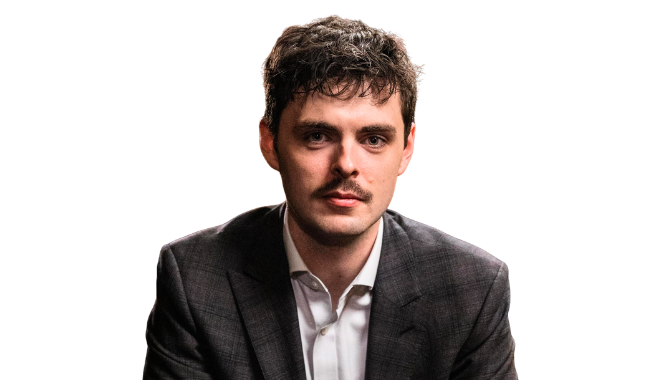

Jay Shetty & Alex O’Connor ON #1 Shift That Stops Overthinking
In this On Purpose episode, Jay Shetty sat down with philosopher and popular media creator Alex O’Connor. They analyzed how humans perceive reality from philosophical, religious, spiritual, and scientific perspectives, highlighting how our brains perceive the world and what drives our daily decisions.
Why do we do what we do? Does it really make sense, or do we just rationalize our feelings to seem logical?
In this On Purpose episode, Jay Shetty sat down with philosopher and popular media creator Alex O’Connor. They analyzed how humans perceive reality from philosophical, religious, spiritual, and scientific perspectives, highlighting how our brains perceive the world and what drives our daily decisions.
From Failed Exams to Oxford
Alex O’Connor is known for his philosophy content and has a reputation for intellectual rigor. But he wasn’t an excellent student in school; he admitted to Jay Shetty. He was a rebel who frequently clashed with teachers and dedicated more time to skateboarding and music than to his studies. Looking back, he thinks it may have been his dismissal of authority that drew him toward the confrontational theater of the New Atheist movement.
When the A-levels came, O’Connor received three unmarked grades; he even overslept one exam. People assumed he lacked the intellectual capacity, which was untrue, and O’Connor suddenly decided to prove everyone wrong. So, motivated by his growing interest in the works of Richard Dawkins and Christopher Hitchens and his friends’ aspirations to attend Oxford, he retook his humanities exams and passed with flying colors. He then attended Oxford himself.
Passion or Purpose?
Intelligence should instead be measured by the ability to perform a specific task with a goal in mind, such as playing an instrument or having architectural intuition, skills that traditional schooling often fails to recognize. In O’Connor’s opinion, the most important task for a young person is to figure out what they are good at and what they enjoy as quickly as possible.
Alex O’Connor argued that people can find meaning in their work in two ways: through passion for the subject itself or through a clear sense of direction and purpose, such as a medical student enduring long hours and hard work, knowing their actions save lives.
Jay Shetty listened to O’Connor’s assertion that danger arises when students have neither passion nor direction, and their pain feels meaningless, which he described as vocational nihilism. While subjects like philosophy may seem unemployable, his passion for the questions themselves allows him to cope with the uncertainty of his career path, a luxury not everyone feels they have.
Witnessing Western and Eastern Spiritual Traditions Unfold
When Jay Shetty asked him which historical moment he would choose to witness, O’Connor had the answer ready. He would be interested in living the foundations of Christianity, especially Jesus’s baptism by John the Baptist. He is intrigued by the historical mysteries surrounding what Jesus actually said and how they compare to later orthodox beliefs. He wishes to understand the nature of Jesus’s relationship with John the Baptist, whether he was John’s disciple initially, an assumption that would challenge traditional biblical interpretation.
Jay Shetty expressed his wish to witness a time when the Bhagavad Gita was spoken, and see warrior Arjuna on the battlefield. But he admitted he would feel a little misled if he found out the event was fictional rather than literal history. O’Connor views religion through a philosophical lens and highlights that some traditions, such as Christianity, are heavily grounded in specific historical claims (such as Jesus’s resurrection). If those claims were proven wrong, the entire worldview would collapse in an instant.
Eastern and Western Interpretations of Consciousness
Jay Shetty was pleasantly surprised to learn about Alex O’Connor’s fascination with the Indian traditions, such as Advaita Vedanta. His deep interest in philosophy and consciousness led him to study non-Western traditions. O’Connor feels that ancient Eastern texts often surpass Western philosophical developments, especially in their view of the mind and body as a fundamental unity rather than two separate entities.
There are three main ways to explain the relationship between the conscious mind and the physical body, O’Connor explained:
- Dualism – Mind and body are separate but interacting substances.
- Materialism – Only dead matter exists, and consciousness is merely a product of atoms arranged in a certain way.
- Idealism – The mental element is the only fundament, and the physical world is a manifestation of the mental reality.
Critiquing the Limits of New Atheism
Alex O’Connor described to Jay Shetty the New Atheists movement, led by figures like Richard Dawkins and Christopher Hitchens, as being primarily concerned with the social evils caused by religion, such as creationism in schools or geopolitically motivated terrorism. But he challenges this view, noting that such critiques often fail to engage with the underlying metaphysical arguments for God’s existence.
For instance, Richard Dawkins attempts to debunk the complex causal arguments of Thomas Aquinas in only two pages of his book, The God Delusion, which O’Connor considers insufficient even to define Aquinas’s terminology. However, he defends his friend Dawkins, telling Jay Shetty that he isn’t interested in philosophy or theology, but focuses on science instead.
In his eyes, a lack in the humanities weakens the movement’s philosophical conclusions, and critiquing religion only for its negative social effects is like saying that politics is bad because it causes wars. While it may be true, it doesn’t mean that one understands political philosophy or that a correct position doesn’t exist.
Science Can’t Explain Why Things Happen
Alex O’Connor asserted that science doesn’t explain the world. He told Jay Shetty that, if you ask “why” something is happening often enough, science will reach a limit. Therefore, it doesn’t explain things; it describes them using mathematical formulas instead.
Isaac Newton described gravity as an invisible pulling force between objects, yet he admitted he had no hypothesis as to what gravity actually is or why it occurs. He produced an elaborate mathematical description of regularities of motion, but the fundamental cause was simply called “gravity”.
Modern people often feel superior to ancient animists because we no longer explain the world through the lens of deities and supernatural forces. But O’Connor made Jay Shetty giggle when he revealed that we had simply replaced these explanations with what we now call “forces.” So, we still can’t explain the why, but only describe more accurately what we observe based on the laws of physics and mathematics.
The Mystery of Consciousness
To Alex O’Connor, consciousness is the foundational mystery of reality. He told Jay Shetty about a time he participated in a panel on consciousness hosted by Brian Cox, where he felt the neuroscientists were talking about brain activity rather than the experience of consciousness itself.
Using Thomas Nagel’s definition, Alex O’Connor defines consciousness as the fact that there is something it is like to be an organism, an inward sense of subjectivity. He argued that while neuroscience can brilliantly describe the neural correlates of consciousness (brain activity during the experience), it can’t explain the experience itself, such as the redness of red or the feeling of cold.
Alex O’Connor told Jay Shetty that many materialists believe mental experiences are identical to brain activity, but Leibniz’s Law states that, in order for two things to be identical, they must share all the same properties. According to this theory, when we picture a triangle in our heads, it has three sides, but the neurons firing in the brain do not have three sides; therefore, they can’t be the same thing. They can be connected or causally linked, but they aren’t identical, so this explanation doesn’t solve the mystery of consciousness.
The Brain’s Two Halves
Ian McGilchrist, a British philosopher and psychiatrist, argued that the two brain hemispheres process the world through different types of attention, with the left brain focused on manipulation and discrete details, while the right brain looks at the big picture and the whole. O’Connor explained to Jay Shetty that we can observe this type of lateralization across the animal kingdom, allowing them to simultaneously look for prey and watch for predators.
The human brain’s division has profound implications for how we perceive our identity and the world around us. O’Connor revealed to Jay Shetty the existence of split-brain patients whose hemispheres were disconnected as treatment for epilepsy. Experiments on these patients showed that the two halves of the brain can possess independent knowledge; for example, the right hemisphere might see an image that the left hemisphere, which controls speech, cannot name, even though the person’s left hand can draw it.1
Most strikingly, when the right brain is given a command to act, the left brain will invent a plausible but false reason for the action, a phenomenon known as confabulation. Alex O’Connor suggests that this happens to all of us constantly; our left brain acts as an interpreter, creating fictive rationalizations for intuitive decisions we have already made.
Don’t Over-Rationalize Your Thoughts
Alex O’Connor admitted to Jay Shetty that his philosophical journey often leaves him with more questions than answers, and he still doesn’t have a definite answer for what makes life good. But he believes we can become more aware of our true motivations if we recognize our brains’ tendency to over-rationalize every decision.
You can apply this knowledge to all areas of your life, O’Connor told Jay Shetty. For example, a couple’s disagreement: while they might think they are arguing about the dishes, the underlying issue is often a right-brain feeling of not being heard or valued.
When we take a step back and pause the immediate impulse to rationalize the behavior, we can better understand the complexities of our own nature and the unified reality that many ancient traditions have pointed to for centuries.
More From Jay Shetty
Listen to the entire On Purpose with Jay Shetty podcast episode “Alex O’Connor: #1 Shift That Stops Endless Overthinking (FINALLY Get Unstuck)” now in the iTunes store or on Spotify. For more inspirational stories and messages like this, check out Jay’s website at jayshetty.me.
1Shen HH. Inner workings: Discovering the split mind. Proc Natl Acad Sci U S A. 2014 Dec 23;111(51):18097. doi: 10.1073/pnas.1422335112. PMID: 25538286; PMCID: PMC4280611.
Sign up for the only email that puts purpose at the center of your day.


Looking for greater meaning? This quiz shows you how to live with purpose every day.
Take the Quiz
Dreaming of becoming a life coach? This quiz tells you if a coaching career is right for you.
Take the QuizDreaming of becoming a life coach? This quiz tells you if a coaching career is right for you.
Take the Quiz
Everyone communicates differently. Discover your own personal fight style now.
Take the Quiz
Understanding your role in a relationship is the first step to making things work.
Take the Quiz

